Knife Sharpening: Correct Techniques for Every Blade Type
There is a counterintuitive truth about knife injuries in home kitchens: the vast majority are caused not by sharp knives but by dull ones. A blade that has lost its edge requires more fo...
There is a counterintuitive truth about knife injuries in home kitchens: the vast majority are caused not by sharp knives but by dull ones. A blade that has lost its edge requires more force to cut, slips unpredictably off curved or smooth surfaces, and exhausts the hand through the compensation required to make it perform. Understanding how to sharpen a knife — and crucially, which method suits which blade — is a safety skill as much as a culinary one.
In brief
Dull knives cause more kitchen injuries than sharp ones. Maintain the edge you have before chasing exotic steel.
Also: How often to hone before you reach for the stone.
Continue in the Journal: Home chef knife guide · Japanese knife shapes · Damascus knives: a material answer · Five knife skills for composure · Forged vs stamped · Honing vs sharpening
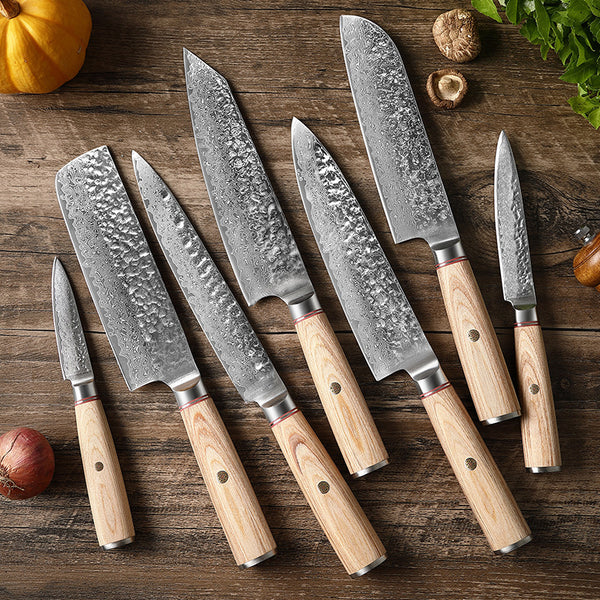
Shop the kit: Forged knife set · browse Master Series knives.
Understanding What Sharpening Actually Does
A knife edge, examined under magnification, is an extremely fine V-shaped wedge. During normal use, the microscopic teeth along this edge gradually roll over, bend, and chip — a process called edge degradation. Honing (using a honing rod or steel) corrects this by realigning rolled teeth back to their original position without removing material from the blade. Sharpening goes further: it removes a small amount of metal from the blade face to create a new, fresh edge. The distinction matters because confusing the two leads to the most common maintenance mistake — using a sharpening tool when you need a honing rod, and vice versa.

A newly sharpened blade that is honed after every second or third use will maintain its edge significantly longer than a blade that is only sharpened periodically with no intermediate maintenance. In practice, most home cooks need to sharpen their primary chef's knife two to four times per year and should hone it briefly before each significant cooking session.
Whetstones: The Gold Standard for Flat-Edge Blades
A whetstone (water stone or oil stone) is the most controllable sharpening tool available to a home cook. It allows precise angle management and produces a finer, more refined edge than most mechanical sharpeners. The grit progression matters: begin with a coarser stone (220 to 400 grit) if the blade is significantly dull or damaged, progress to medium (1000 grit) for the main sharpening work, and finish with a fine stone (3000 to 6000 grit) to polish and refine the edge.
Maintaining consistent angle is the most technically demanding aspect of whetstone sharpening. German knives are typically sharpened at 20 to 22 degrees per side; Japanese knives at 15 to 17 degrees per side. A simple angle guide slipped over the spine of the blade is an entirely legitimate tool for developing muscle memory before attempting freehand sharpening. The backstroke (pulling the blade toward you across the stone, spine leading) on each side of the blade should be uniform in pressure and pace. Circular motions and excessive downward pressure accelerate steel removal without improving edge quality.

Electric Sharpeners: Convenience and Its Trade-Offs
Pull-through electric sharpeners with tungsten carbide or abrasive wheel slots remove metal quickly and produce a usable edge without technique. Their limitation is precision: most are pre-set to fixed angles that do not optimally suit every knife in a typical home collection. They are also aggressive — frequent use on a high-quality Japanese knife will shorten its lifespan considerably more quickly than disciplined whetstone use. For European-style knives that will be resharpened numerous times over decades, this trade-off is more acceptable. For a single high-investment knife, whetstone sharpening is the responsible long-term choice.
Serrated Knives: The Maintenance Problem Most Guides Skip
Serrated blades — bread knives, tomato knives, steak knives — require a fundamentally different maintenance approach than flat-edge blades. The teeth along a serrated edge cannot be sharpened with a flat whetstone, a pull-through sharpener, or a standard honing rod. Each tooth is individually curved and must be addressed independently with a pointed, tapered rod that matches the curvature of the tooth gullet (the valley between teeth).

Diamond-coated honing rods are the standard tool for serrated blade maintenance. The diamond abrasive surface is fine enough to sharpen without removing excessive metal, and the taper of the rod allows it to reach into the gullet of even fine-toothed serrations. The technique requires patience: each tooth or group of two to three teeth is addressed individually with three to five light strokes of the rod, applying minimal pressure. The burr (a thin curl of metal displaced to the flat face of the blade) is removed with a single pass of a fine whetstone across the flat side.
"Serrated knives can go years without attention and still cut bread. But when they finally dull, the home cook who knows the diamond rod technique will save a knife that most people would discard."
Stropping and the Final Polish
Stropping — drawing the blade across a piece of leather or a fine-grit strop — is the final step in any proper sharpening sequence. It removes the burr that sharpening inevitably creates along the blade's edge and aligns the microscopic teeth of the newly formed edge in one consistent direction. A strop loaded with a small amount of honing compound (typically chromium oxide, which appears as a green paste) produces a mirror-polish edge that exceeds what even a fine whetstone can achieve alone.
The physical skill of knife sharpening is acquired gradually, and the earliest attempts will produce a blade that is better than before even if the technique is imperfect. Consistency over sessions is more valuable than perfection in a single session. The rewarding feedback loop — feeling the blade glide through a ripe tomato without pressure, hearing the clean whisper of a sharp edge through a folded sheet of paper — is sufficient motivation to make the practice permanent.
A sharp knife starts with the right steel. Keep a dependable forged set on the block — hand-forged kitchen knives — and browse the knife collection when you are ready to replace a dull blade.
Related: home chef knife guide.