Home Chef Knife Guide: Choosing the Right Blade for Your Kitchen
The knife section of any kitchen equipment store is an exercise in misdirection. Imposing 25-centimetre blades hang at eye level, their length implying authority. The reality is that most of those knives were designed for professional cooks processing hundreds of kilograms of product per shift — not for a home kitchen where a single dinner service might require half an onion, two chicken breasts, and a handful of herbs.
Why Professional-Scale Knives Underperform at Home
The logic of a commercial kitchen knife is volume efficiency: the longer the blade, the more surface contact per stroke, the faster the throughput on repetitive tasks like breaking down cases of vegetables. In a home kitchen, this logic inverts. A 25-centimetre blade on a standard domestic cutting board — typically 35 by 25 centimetres — leaves almost no manoeuvring room. The knife's heel risks the back edge of the board on every forward stroke; the tip overhangs the front. The result is a constant series of micro-adjustments that interrupt technique and reduce precision.

The 16 to 19-centimetre chef's knife occupies the genuine sweet spot for home use. It provides sufficient blade length for breaking down whole chickens or slicing a large butternut squash, while remaining fully controllable on standard cutting board dimensions. Its weight, typically 175 to 225 grams, is manageable across a full cooking session without the forearm fatigue that heavier professional blades induce.
Blade Geometry: Curved vs. Flat, and What Each Does
The side profile of a chef's knife blade is not a stylistic choice — it determines the cutting motion the knife is designed to perform. A German-style knife (brands like Wüsthof and Henckels built their reputation here) features a pronounced belly curve running from heel to tip. This curve is optimised for the rocking motion: the tip stays in contact with the board as the heel rises and falls in a rhythmic chop. The rocking motion is fast, efficient for high-volume mincing, and forgiving of imprecise technique — the curve provides natural guidance.
Japanese-style knives — particularly the gyuto, the Japanese chef's knife — typically feature a flatter belly profile and a thinner blade ground to a more acute angle. This geometry is designed for the push cut: a forward-and-down slicing motion that draws the full length of the blade through the ingredient in a single stroke. The push cut produces thinner, more precise slices than rocking, and it is the technique preferred for fish, raw proteins, and any work requiring clean, unblemished cuts. The trade-off is that the flatter profile requires more deliberate technique — the knife does not guide the motion the way a German blade does.

The Steel Variable: Hardness, Flexibility, and Maintenance
Steel hardness, measured on the Rockwell scale (HRC), determines how fine an edge a knife can take and how long it will retain that edge. Most German knives are manufactured to 56 to 58 HRC — a hardness that produces a durable, slightly flexible edge that is forgiving of lateral stress and easy to maintain with a honing rod. Japanese knives often reach 60 to 66 HRC, enabling a razor-fine edge at more acute angles, but requiring more careful technique and a whetstone rather than a honing rod for maintenance. Higher hardness also means higher brittleness: dropping a Japanese knife tip-first onto a stone floor is likely to chip the blade; the same accident with a German knife typically results in a bent edge that can be straightened.
"A sharp knife at 58 HRC that you maintain every week outperforms a 66 HRC blade you sharpen once a year. Edge geometry matters more than steel specification in most home kitchen contexts."
Handle Design and Ergonomics
The handle determines whether a knife is comfortable for a one-hour cooking session or an ordeal. The pinch grip — where the index finger and thumb pinch the blade itself above the bolster rather than wrapping the full hand around the handle — is the technique taught in culinary schools for both control and safety. A knife designed for the pinch grip will have a bolster (the thickened junction between blade and handle) that is comfortable against the index finger and a handle that does not force the remaining fingers into awkward positions.

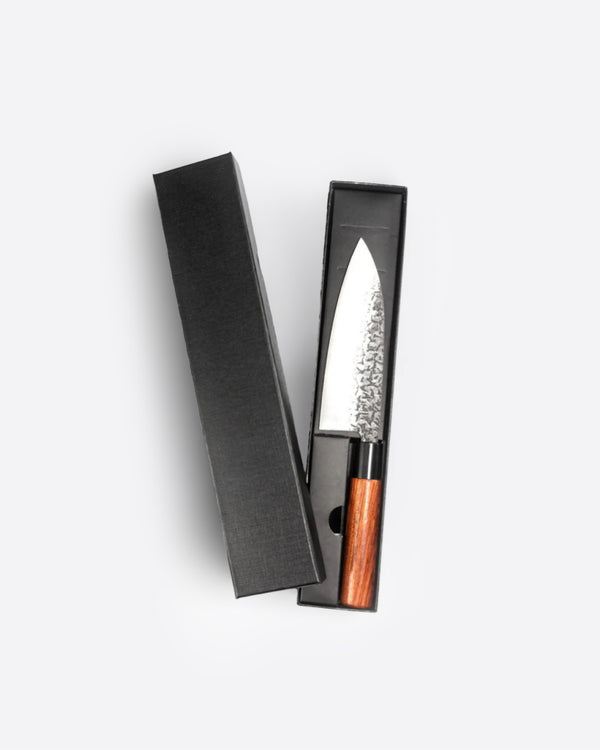
Western-style handles, often made from riveted composite, wood, or polymer, are oval or D-shaped in cross-section and suit cooks who prefer the full-wrap grip. Japanese wa handles, typically made from octagonal magnolia or ho wood, are lighter, narrower, and specifically designed for the pinch grip. Neither is objectively better; both are ergonomically deliberate.
Building a Practical Home Knife Set
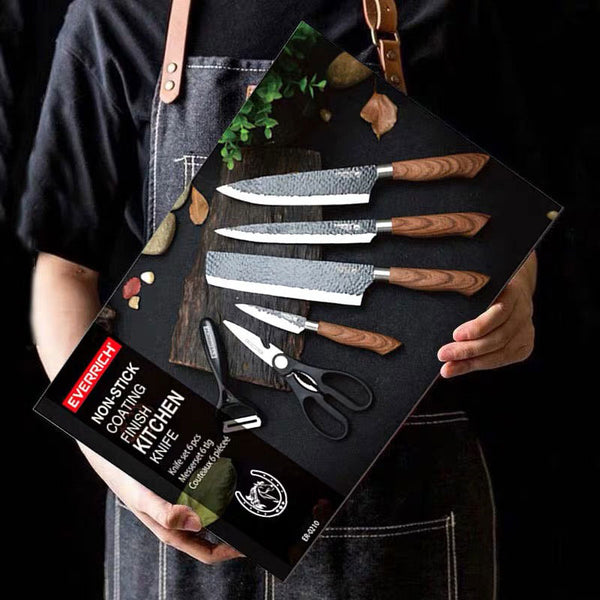
A three-knife set covers the vast majority of home cooking tasks without redundancy. The chef's knife or gyuto (16 to 19 cm) handles the majority of cutting work. A paring knife (8 to 10 cm) handles detail work — deveining, trimming, fine cuts — where a full-size blade would be imprecise. A serrated bread knife (20 to 25 cm) handles crusty bread and tomatoes without crushing. Everything beyond these three — boning knives, cleavers, sujihiki slicers — is category-specific and best purchased when a specific task demands it rather than as a default addition to the kitchen drawer.
The best knife in your kitchen is the one that fits your hand, suits your dominant cutting technique, and that you sharpen regularly. Technical specifications are the beginning of the decision — comfort and consistency of use are how the decision is ultimately validated.